It seems like so many of our legends and myths come
from really insightful observations about daily life.
And we keep making these same observations over and over.
Look! It's the modern day Sisyphus!

Step by step, heart to heart, left right left
We all fall down like toy soldiers
Bit by bit, torn apart, we never win
But the battle wages on for toy soldiers
~Eminem (Toy Soldiers)
Thursday, June 22, 2006
Toy Soldiers

Wednesday, June 21, 2006
Why Programming Can Be Addictive
Unlike many professional activities, programming often offers an immediate reward. For instance, you can spend a day writing a program and immediately have a tangible result as a testimony of your accomplishment. Not only does programming allow for creativity in what you make, but it also let's you choose how you accomplish what you want. Unlike many jobs, you often aren't restricted by some rigorous procedure of solving a problem, which most people find boring. And even the horrible moments of programming (debugging, understanding code, setting up computers and the like) actually add to the allure of programming, because these terrible moments make your accomplishments that much more important. In programming, you are given the freedom to approach a problem however you like, take on the challenges, and come out victorious (if you persist enough, that is). It is an immediate and very tangible form of goal-challenge-reward that so many of us enjoy. That's why programming is so addictive.
Sunday, June 18, 2006
Sleeping in Seattle

I decided to read on the floor today instead of in my usual chair for a change. The book I was reading was interesting, but at times the technical jargon overwhelmed me and I felt myself slowing down and getting a bit sleepy. If I had known what tragedy awaited me on that carpet, I never would have laid down.
I had gotten to a particularly dreary portion of my book, when suddenly the sun came out, and began shining its warm, soothing rays onto my head. As I began slowing down, reading every other word, the sun would fill in my lapses with its soothing lullaby. I began thinking more of sleep and less about my book until the sun finally spoke to me, saying, "It's okay to take a nap, just a little daze, that's all. Naps are healthy! They rejuvinate your body and your mind." I must say, the suns testimonial was quite convincing, so I put my arms down and slowly drifted into sleep...
Apparently I napped for quite a while, because my mom managed not only to spot me, but to take her camera out and snap several pictures of me, without my even noticing!
 I finally heard the camera's clicking, and slowly opened my eyes, to see what was up. But, the damage was already done. The photos were taken, and I could do nothing but take the photos with good humor. So I smiled and let my mom take one last picture. The End.
Saturday, June 17, 2006
Socks!
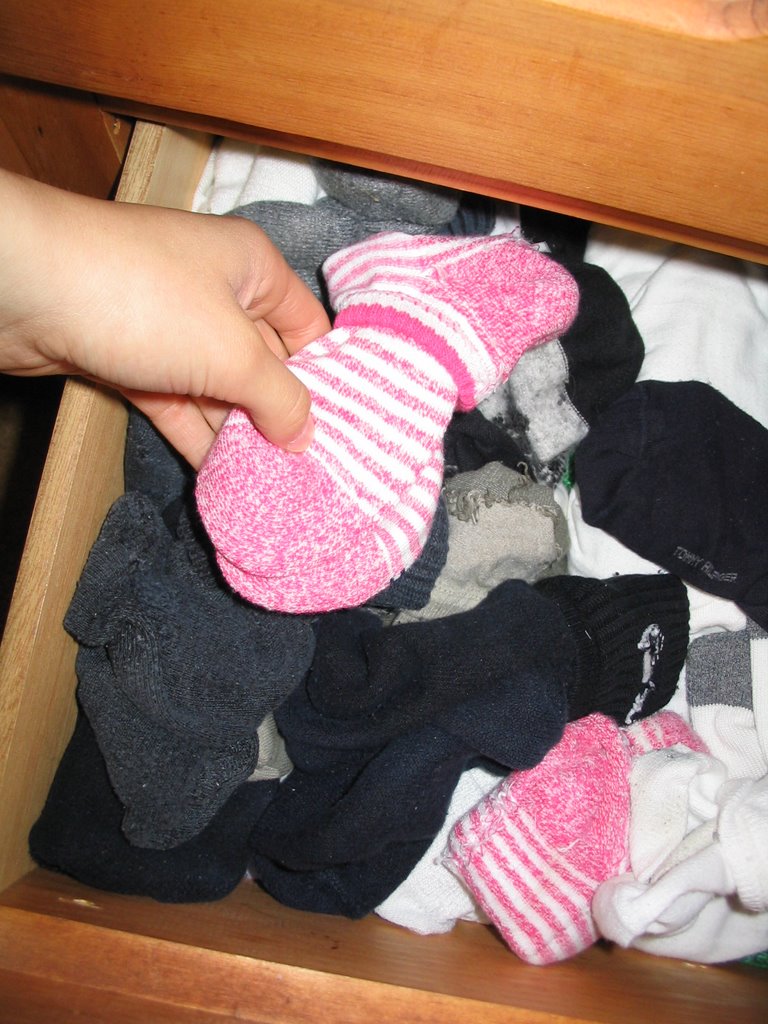
You have a certain number of socks in your drawer. But, because you have no sense of style, the only colors your socks come in are red and black. If you draw two socks at random (without replacing them into the drawer...that'd just be silly) the probability of you getting two red socks is 1/2. What is the minimum number of socks you need for this to be true? For a harder version, what is the minimum number of socks you need for this to be true AND for there to be an even number of black socks?
Monday, June 12, 2006
A Puzzle
I was going to write about African child laborors working in copper mines, but instead I'll give you a puzzle.
I found it from a search on the word "google puzzle"
I found it from a search on the word "google puzzle"
"Using the numbers 3, 3, 8, 8 (in any order), make a mathematical expression that equals 24. You can use only addition, subtraction, multiplication, and division (and parentheses), but in any order you wish. Note that you have to use all four numbers; otherwise 3 times 8 would be valid -- and that wouldn't be much of a puzzle, would it?"
There's also a nice solution where you can use any mathematical operators you know (and have been proven beyond a doubt).A Puzzle
I was going to write about African child laborors working in copper mines, but instead I'll give you a puzzle.
I found it from a search on the word "google puzzle"
I found it from a search on the word "google puzzle"
"Using the numbers 3, 3, 8, 8 (in any order), make a mathematical expression that equals 24. You can use only addition, subtraction, multiplication, and division (and parentheses), but in any order you wish. Note that you have to use all four numbers; otherwise 3 times 8 would be valid -- and that wouldn't be much of a puzzle, would it?"
There's also a nice solution where you can use any mathematical operators you know (and have been proven beyond a doubt).Saturday, June 10, 2006
Death of Zarqawi
Three Women and a Child Dead With Zarqawi
On Thursday CNN asked Americans what they thought about Zarqawis death. It seems like most people are happy, they are almost rejoicing now that this evil person is dead. But I don't think it was right to kill Zarqawi. Detain him, maybe, but not kill him. It doesn't seem like violence is the solution here. Revenge begets revenge, and this will only make Zarqawi's followers hate us more.
We couldn't even kill just Zarqawi. We had to kill a girl and three women along with him. We couldn't even do a clean job.
But that's beside my point. My point is that killing Zarqawi probably wasn't the best option we had given our information (his location, and presumably the means to get there). We're probably just fueling the conflict, not abating it.
On Thursday CNN asked Americans what they thought about Zarqawis death. It seems like most people are happy, they are almost rejoicing now that this evil person is dead. But I don't think it was right to kill Zarqawi. Detain him, maybe, but not kill him. It doesn't seem like violence is the solution here. Revenge begets revenge, and this will only make Zarqawi's followers hate us more.
We couldn't even kill just Zarqawi. We had to kill a girl and three women along with him. We couldn't even do a clean job.
But that's beside my point. My point is that killing Zarqawi probably wasn't the best option we had given our information (his location, and presumably the means to get there). We're probably just fueling the conflict, not abating it.
Friday, June 09, 2006
How Ironic...
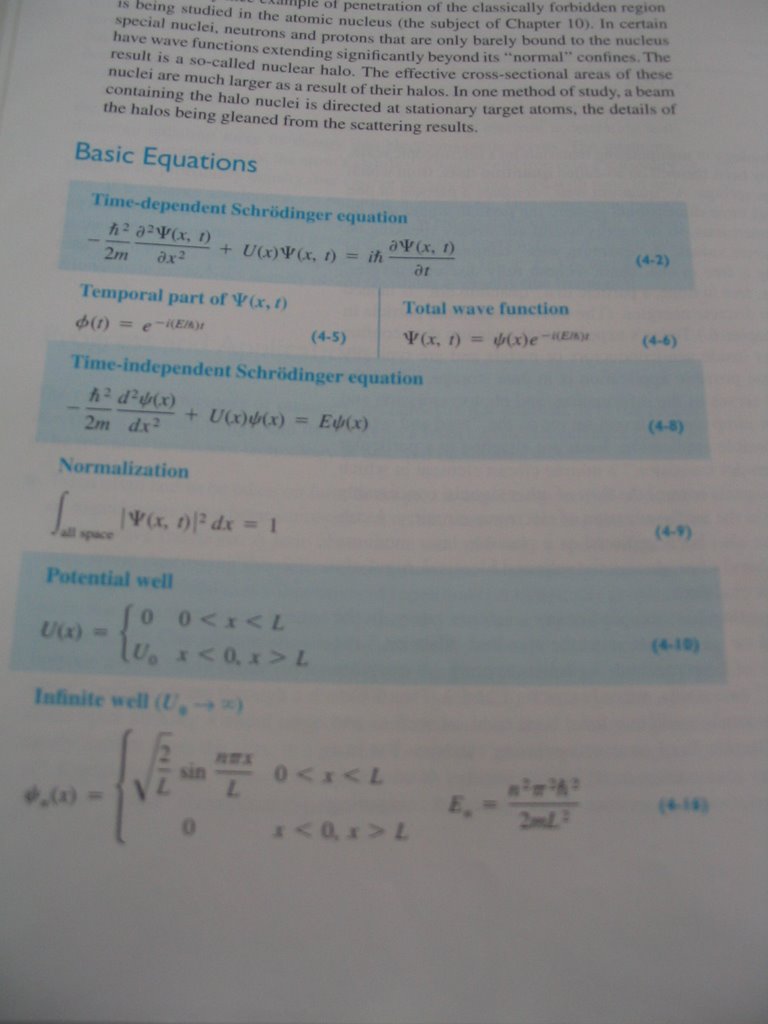 In case you can't read it, the top says "basic equations." I snapped that photo a few weeks back on my way to school. I was trying to make sense of Schrodinger's equations for a test I had that day, I believe.
Thursday, June 08, 2006
A Note on Triviality
Something that is trivial is clear, easy and obvious. But triviality is relative. For example, Chinese people might think the Chinese language is trivial, but it is incredibly complicated for everyone else. They key here is to consider your audience (your frame of reference, in physics terms). If I tell you that juggling is easy and trivial, that won't encourage you much, will it? So even if juggling, or math, or whatever you do is easy for you, that's not what's important when communicating with people. What matters is how they view the topic at hand.
So the next time a student asks you "what's the sine of pi/2?" don't say "that's trivial!" Just calmly explain that it's one, and make sure to explain why.
So the next time a student asks you "what's the sine of pi/2?" don't say "that's trivial!" Just calmly explain that it's one, and make sure to explain why.
Wednesday, June 07, 2006
Talk About A Demoralizing Teacher
So, today my physics teacher basically told me I suck at physics and should not pursue physics because I'm terrible at it. He said something along the lines of,
"If you were a doctor and you knew medicine like you knew physics, I wouldn't want to be your patient. Nobody would want to be your patient, because you'd be terrible"
Then he went on to say,
"You should only do what you're good at. If I were you I'd pick one thing, one goal, one thing I'm good at and strive for it."
I completely agree with both statements, (especially the latter), and think I will drop the physics major in favor of computer science (if I get in, that is).
But just in case you were wondering, telling your students that stuff they think is hard is "trivial" (as my professor pointed out, the integral of x^2 exp(-(x-3)^2) from neg. infinity to infinity is trivial) and telling them they suck at whatever it is your teaching isn't the best way to get a student excited about a topic. Even if the student sucks, don't tell them that. Telling someone they suck at something isn't going to make them like or learn it any better.
"If you were a doctor and you knew medicine like you knew physics, I wouldn't want to be your patient. Nobody would want to be your patient, because you'd be terrible"
Then he went on to say,
"You should only do what you're good at. If I were you I'd pick one thing, one goal, one thing I'm good at and strive for it."
I completely agree with both statements, (especially the latter), and think I will drop the physics major in favor of computer science (if I get in, that is).
But just in case you were wondering, telling your students that stuff they think is hard is "trivial" (as my professor pointed out, the integral of x^2 exp(-(x-3)^2) from neg. infinity to infinity is trivial) and telling them they suck at whatever it is your teaching isn't the best way to get a student excited about a topic. Even if the student sucks, don't tell them that. Telling someone they suck at something isn't going to make them like or learn it any better.
Tuesday, June 06, 2006
Solution to Post Problem
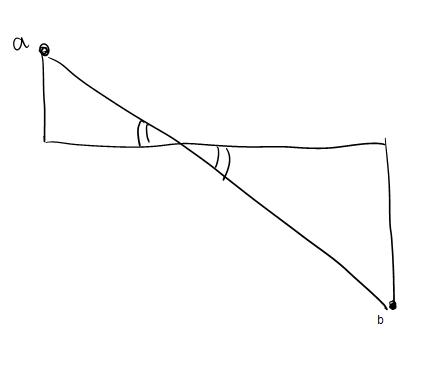 I think it's finally time to post the solution to the post problem I posted earlier. The trick is to simply flip the b post upside down. Now, we all know that the shortest distance between any two points is a straight line, and thus the shortest distance from a to b is a straight line. But since ab is a straight line, then theta 1 and theta 2 must be equal by the "opposite angle" theorem (I made it up...don't know what it's called). And that's all, folks!
Actually, another cool fact about this is that this actually proves why the angle of incidence always equals the angle of reflection!
Monday, June 05, 2006
Tests as a Way of Controlling People
I have an idea that I thought I'd throw out (to get some feedback). Sometimes it seems like tests are a way to control people, to basically manage what people do for a short period of time and make them all do one particular thing (take the test). Tests keep people studying, keep people in check lest they do something different. I'm not sure if this is at all valid, but it's a thought.
Sunday, June 04, 2006
A Puzzle
Here's a problem that my dad and I came up with today:
n friends are drawing straws to see who will be the designated driver. Instead of drawing straws the usual way, however, a guy draws a straw, and if it's shorter than the rest the guy gets/has to be the designated driver. If it's not shorter than the rest, however, the guy puts the straw back into the pile. Is this a fair game? If not, which person should you be if you don't want to draw the shortest straw?
n friends are drawing straws to see who will be the designated driver. Instead of drawing straws the usual way, however, a guy draws a straw, and if it's shorter than the rest the guy gets/has to be the designated driver. If it's not shorter than the rest, however, the guy puts the straw back into the pile. Is this a fair game? If not, which person should you be if you don't want to draw the shortest straw?
Tuesday, May 30, 2006
Language and Identity
One of my English students is writing a paper about the impact of Language on self-identity for immigrants who have travelled to America. Here's my take:
Language's on one's self identity is directly proportional to how much a person values language in the first place. The more one cares about and preserves his/her language, the more it affects his/her identity. I will use myself as an example to illustrate my point.
Because I care about my language, I make a special effort to remember and speak Russian at home. As a result, I view myself differently in different situations. In public (where I speak English) I view myself as American, wheras at home (where I speak Russian) I see myself as Ukranian. My language also affects how others view me. When others find out I speak Russian, they can no longer think of me as a pure American. Rather, I assume I become somewhat of a hybrid comunocapitalist SlavoAmerican.
On the other hand, a person who doesn't care about language cannot possibly identify himself based on his language simply because he doesn't care about it! This person may define himself as an American based on the flag he puts on his lawn, or the French fries he consumes, but not by language. Similarly, others will not identify this person by his language since that's not what makes him unique. People that don't care about language generally adopt the language of their surroundings, and learning that an Italian speaks Italian isn't exactly interesting. As a result, language does not affect the identity of a person who does not care about language.
So what does my epic tell us? That if you ever hear some English professor trying to stuff the idea that language and identity are "intimately interconnected", make sure to take this statement with a grain of salt.
Language's on one's self identity is directly proportional to how much a person values language in the first place. The more one cares about and preserves his/her language, the more it affects his/her identity. I will use myself as an example to illustrate my point.
Because I care about my language, I make a special effort to remember and speak Russian at home. As a result, I view myself differently in different situations. In public (where I speak English) I view myself as American, wheras at home (where I speak Russian) I see myself as Ukranian. My language also affects how others view me. When others find out I speak Russian, they can no longer think of me as a pure American. Rather, I assume I become somewhat of a hybrid comunocapitalist SlavoAmerican.
On the other hand, a person who doesn't care about language cannot possibly identify himself based on his language simply because he doesn't care about it! This person may define himself as an American based on the flag he puts on his lawn, or the French fries he consumes, but not by language. Similarly, others will not identify this person by his language since that's not what makes him unique. People that don't care about language generally adopt the language of their surroundings, and learning that an Italian speaks Italian isn't exactly interesting. As a result, language does not affect the identity of a person who does not care about language.
So what does my epic tell us? That if you ever hear some English professor trying to stuff the idea that language and identity are "intimately interconnected", make sure to take this statement with a grain of salt.
Wednesday, May 24, 2006
My Next Program
Below is the logo for my next program, InkChat. The program allows you to chat with your friends not only with text, but also with a pen! Anyway, I'd really appreciate everyone's opinions about the logo. And don't say it's good because you know me, or don't want to offend me. I'd be offended if you couldn't be honest enough to say it needed some work. Because obviously it does. My main dilemma right now is the ink puddle, and the splotch under the "k" do I include those or not?

Thursday, May 18, 2006
A Cool Problem
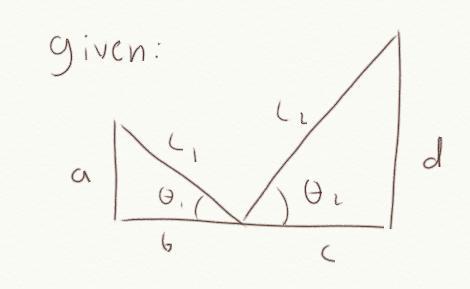 I saw this problem on the whiteboard of the EEP lounge today. So here it is: you're given two posts of height a and d, and you have a string connecting these two posts tied down to the ground at some point. Show that the minimum length of the string is given when theta1 = theta2. (Hint: you don't need to use calculus, trigonometry or even the pythagorean theorem!).
Wednesday, May 17, 2006
Quantum Mechanics in less than 50 words
There are 3 basic principles of elementary quantum mechanics, and here they are (in less than 50 words...numbers don't count as words):
1) Any object acts like a particle or wave, depending on how it's observed.
2) Energy of particle = 6.63 * 10^-34 * frequency of corresponding wave.
3) You cannot exactly know the position and speed of a particle at the same time. (uncertainty in speed) * (uncertainty in position) = .5 * 10^-34.
It is NOT true that there is a chance that you can walk through walls or somehow be at a different location (within what we can measure, anyway). You are way too big for quantum mechanics to have any real effect on you.
Now you can say that you know more quantum mechanics than most people do in the world! Give yourself a pat on the back.
1) Any object acts like a particle or wave, depending on how it's observed.
2) Energy of particle = 6.63 * 10^-34 * frequency of corresponding wave.
3) You cannot exactly know the position and speed of a particle at the same time. (uncertainty in speed) * (uncertainty in position) = .5 * 10^-34.
It is NOT true that there is a chance that you can walk through walls or somehow be at a different location (within what we can measure, anyway). You are way too big for quantum mechanics to have any real effect on you.
Now you can say that you know more quantum mechanics than most people do in the world! Give yourself a pat on the back.
Monday, May 15, 2006
This is What Studying Physics Feels Like:
 While I was trying to figure out whether I should be using radians or degrees to figure out the intensity of a diffraction/interference pattern at 5 degrees from the center of a screen, this ant queen sort of stumbled into my room. It sort of wandered about for about 3 minutes on my physics textbook, so I took a picture. Apparently, this ant queen was very camera shy because shortly after I took a picture it started frantically running about, so I decided to stop torturing the poor thing and let it out. It's funny, but sometimes I feel just like the ant queen did while it was wandering around my physics textbook: stumbling upon equations and formulas, trying to tackle something of enourmous proportion. I especially feel that way now that I have to learn most of quantum mechanics in one day (I have a test the day after tommorow). Oh well, I at least have to give it a try...
Sunday, May 14, 2006
In Honor of My Mother
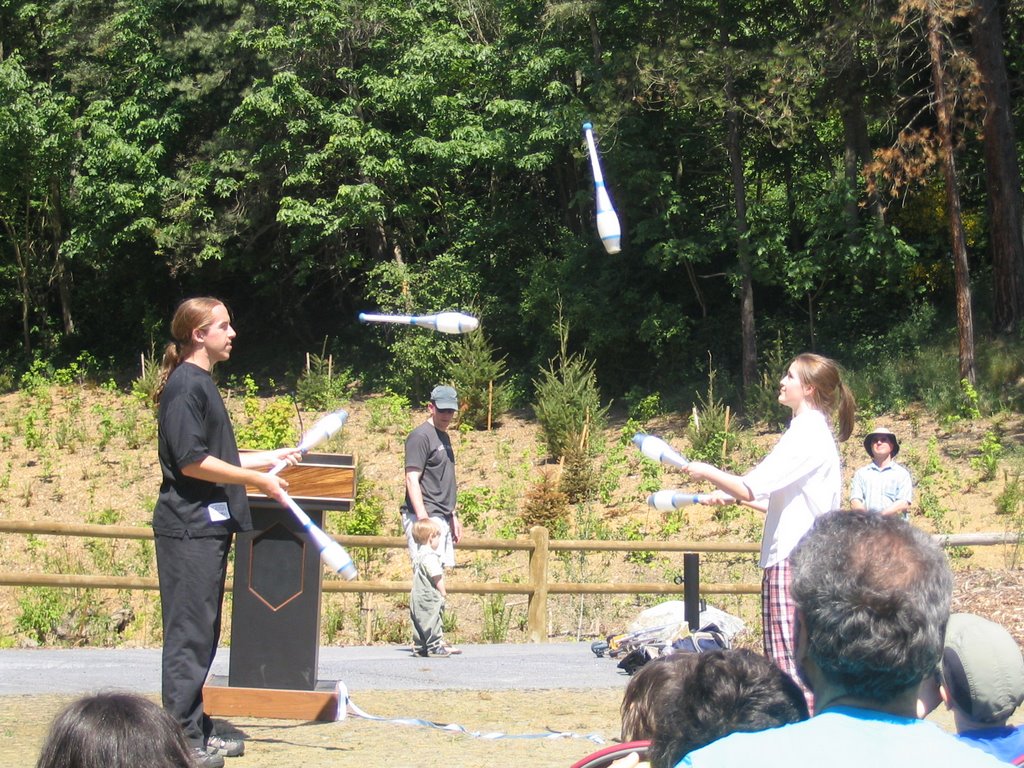 Plaid Pants: $10
6 Juggling Clubs: $210
Boom Box: $30
Sunscreen: $3
Having a mom who made this picture possible: priceless.
Photo: A friend of mine and I performing today at the celebration of the Ravenna creek daylighting in the U. District.
Friday, May 12, 2006
Asking Questions in Class
There is a big email discussion going on amongst some students about whether a certain physics course is good. Here's what one person had to say about it:
"
>Honestly, it's not that
> bad. Just take it. Everyone who's cool and hardcore will think you're
> awesome. Besides, if you have any common sense it's easy. I do warn
> about some of the rather...talkative students with a penchant for asking
> questions without prior reflection.
"
There are two sentences that bug me about this evaluation. 1) "Everyone who's cool and hardcore with think you're awesome" and 2)"I do warn you about some of the rather...talkative students with a penchant for asking questions without prior reflection."
Today I'm going to adress the second sentence.
I'll say up front that yes, it is not a great idea to ask questions without thinking about whether they are worth asking first. These terrible, annoying people should shut their pieholes for once and think a little.
But this is usually not the problem. Far too often students will reflect and ponder their question so much that by the time they decide to ask the question, the lecture has already moved on. Usually they don't even reflect upon the right thing! Instead of wondering if their question has an obvious answer, the student wonders, "will this question make me look stupid? Will I look like I don't understand the material." The answer is yes. Since you have a question, you probably don't understand the material, and yes, you will look stupid. At least to those hardcore guys who have any common sense. But I assure you, these people are in the minority. And honestly, who cares if those hardcore people think you're stupid? You know you're not stupid. You know everyone is asking the same question, so just suck it up and ask already.
Thinking before you ask is important. But it's better to ask a little quickly than to not ask at all. Why? Because not asking questions destroys people's innovation and curiosity. Once you stop verbally asking questions, eventually you will stop thinking of questions, and just learn to accept your reality. I can assure you that most innovators (Einstein, Bohr, DeBroglie), the REALLY hardcore people, did ask questions. Lots of them. They were probably a little annoying, and sure, occasionally got so caught up in questioning that they may not have thought before asking.
I don't know about you, but I'm sort of glad that these people so vigorously questioned what they were learning. I certainly wouldn't be upset if sometimes they asked a question which to me seemed either ridiculous or obvious. How do you think great discoveries are made?
One finaly question: why are we paying these professors so much money if we could learn all the material equally well from a textbook? So that we can ask our professors questions, regardless of how stupid they may be.
"
>Honestly, it's not that
> bad. Just take it. Everyone who's cool and hardcore will think you're
> awesome. Besides, if you have any common sense it's easy. I do warn
> about some of the rather...talkative students with a penchant for asking
> questions without prior reflection.
"
There are two sentences that bug me about this evaluation. 1) "Everyone who's cool and hardcore with think you're awesome" and 2)"I do warn you about some of the rather...talkative students with a penchant for asking questions without prior reflection."
Today I'm going to adress the second sentence.
I'll say up front that yes, it is not a great idea to ask questions without thinking about whether they are worth asking first. These terrible, annoying people should shut their pieholes for once and think a little.
But this is usually not the problem. Far too often students will reflect and ponder their question so much that by the time they decide to ask the question, the lecture has already moved on. Usually they don't even reflect upon the right thing! Instead of wondering if their question has an obvious answer, the student wonders, "will this question make me look stupid? Will I look like I don't understand the material." The answer is yes. Since you have a question, you probably don't understand the material, and yes, you will look stupid. At least to those hardcore guys who have any common sense. But I assure you, these people are in the minority. And honestly, who cares if those hardcore people think you're stupid? You know you're not stupid. You know everyone is asking the same question, so just suck it up and ask already.
Thinking before you ask is important. But it's better to ask a little quickly than to not ask at all. Why? Because not asking questions destroys people's innovation and curiosity. Once you stop verbally asking questions, eventually you will stop thinking of questions, and just learn to accept your reality. I can assure you that most innovators (Einstein, Bohr, DeBroglie), the REALLY hardcore people, did ask questions. Lots of them. They were probably a little annoying, and sure, occasionally got so caught up in questioning that they may not have thought before asking.
I don't know about you, but I'm sort of glad that these people so vigorously questioned what they were learning. I certainly wouldn't be upset if sometimes they asked a question which to me seemed either ridiculous or obvious. How do you think great discoveries are made?
One finaly question: why are we paying these professors so much money if we could learn all the material equally well from a textbook? So that we can ask our professors questions, regardless of how stupid they may be.
Subscribe to:
Posts (Atom)
